
Like pizza? God knows I do! And so do my kids and probably everyone you know. Which ones? Everyone has a favorite. I used to love a good Calzone, with ham, eggs, cheese and mushrooms. Haven’t found that one again on this side of the Atlantic ( i.e. the U.S. of A.)
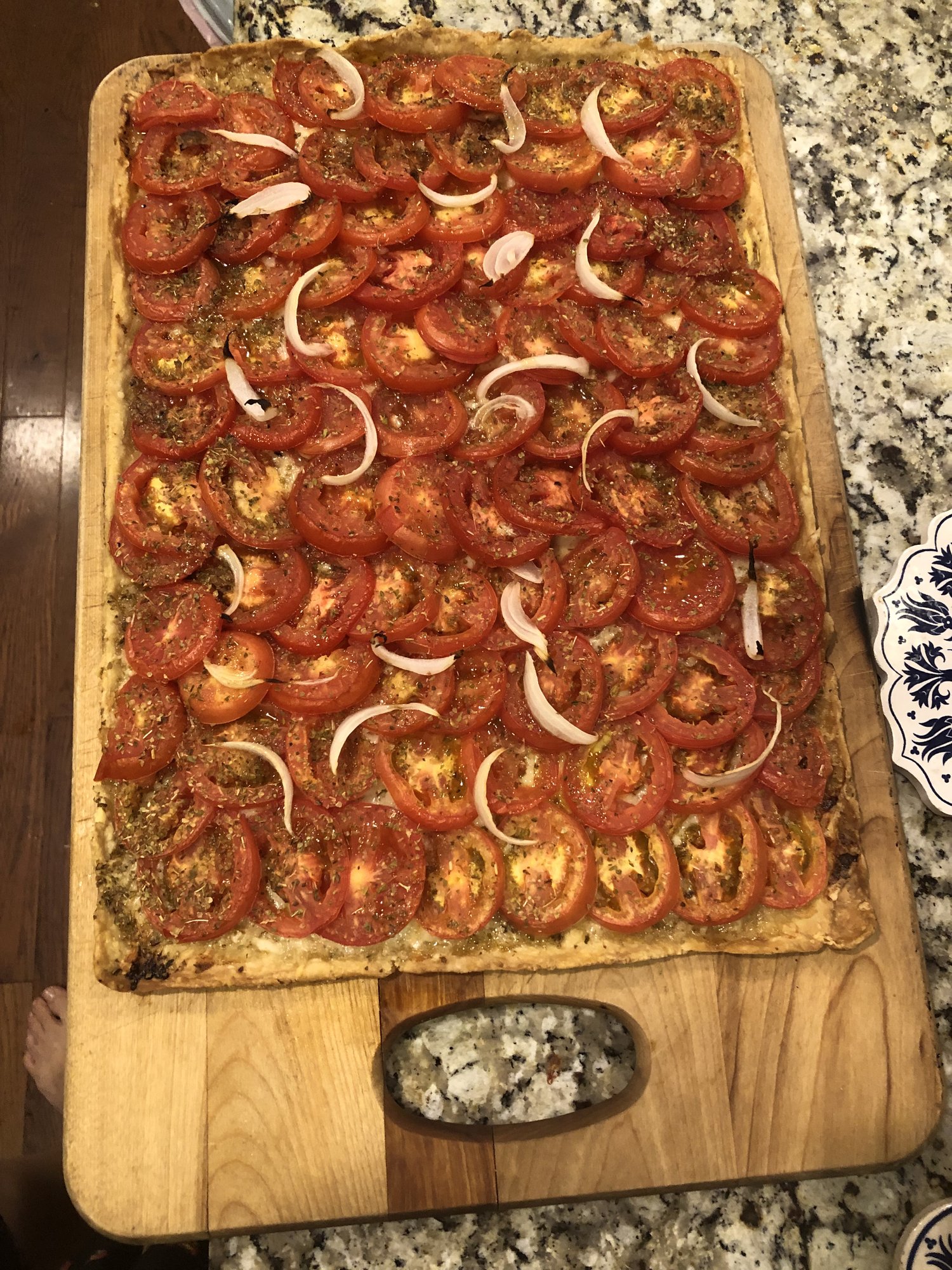
Growing up, we didn’t have pizza often but my mom would make us make our own. But we did it without any recipe book! When I did mine, I would use sliced fresh tomatoes as a base instead of tomato sauce. Imagine my surpise when I once ate something looking like this tomato tarte ! By then I knew how to make real pizza. But this one looked like my awkward (albeit it YUMMY !) “pizza ” from before, but no cheese on top.
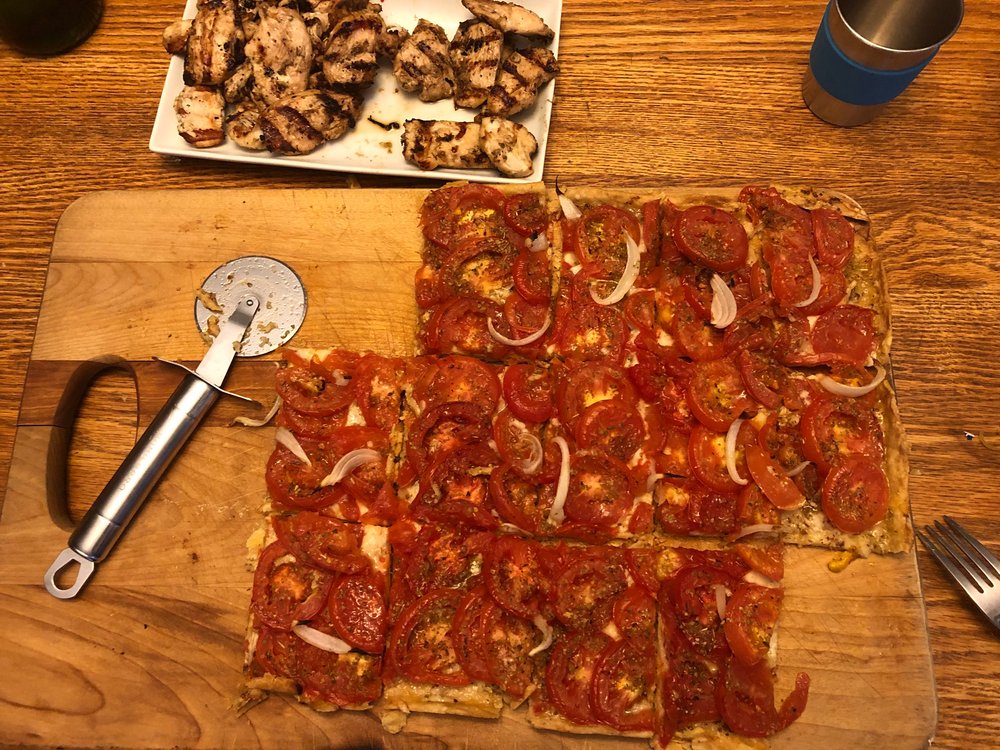
This tarte/torte (Americans, please, what’s the right word?) that used crust and cheese UNDER the tomatoes and at first I was skeptical. But I tried and it turned out delicious! So I recreated it with my own ingredients : tomatoes (not even the organic ones! The bland, Roma tomato from any conventional store), ancient style mustard, an Italian hard sheep cheese called Pecorino – because as I explained in my last post, I avoid cow’s dairy products – and onions – because I like onions everywhere. The crust is my own recipe, that uses a landrace ancient wheat called einkorn, not crossed with any grass or grain, existing for thousands of years, making it low in gluten and very nutritious.
Using Ancient Grain, Especially Einkorn
I am a health coach and a healthy (steamed) foods advocate. However, einkorn is a choice I’ve made for my own family’s nutrition a while ago. Like everyone, around 2005, I started seeing increasing numbers of gluten intolerances including in my family that was very healthy! So, when I moved to the United States, I decided to make sure to NOT become gluten intolerant by using ancient grains, old grains, organic unprocessed grains. And I wished that for my kids too.
It was an easy choice, even if I would have to eat less on account of the price. The taste was so much better! The flavor of Einkorn, Kamut, Emmer and Spelt, the most famous ancient grains from the wheat family, is full, nutty, more complex. Unprocessed grains are also nutrient dense.
This is not Steamed Food
This blog is devoted to informing you and providing you with delicious examples of recipes of steamed foods. However, when I don’t steam, I also develop recipes with ancient grains, probiotics ( sauerkraut, kombucha, probiotic yogurt), or yummy marinades. I also develop recipes with ancient grains, probiotics ( sauerkraut, kombucha, probiotic yogurt), or yummy marinades. I hope I can give you useful information and motivation to start on your health and yummy journey, together with your family.
I use einkorn to make pizza dough, quiche dough, and tarte or pie dough. I use it also for cakes that aren’t gluten free. Einkorn, has a nutty flavor. I grind it myself, or use all purpose einkorn flour from Jovial foods.
WHY ANCIENT GRAIN / EINKORN ?
I am a health coach and a healthy (steamed) foods advocate, but einkorn is a choice I’ve made for my own family’s nutrition a while ago. Like everyone, around the 2005s I started seeing increasing numbers of gluten intolerances including in my family that was very healthy! So, when I moved to the United states, I decided to make sure to NOT become gluten intolerant by using ancient grains, old grains, organic unprocessed grains. And I wished that for my kids too. It was an easy choice, even if I would have to eat less on account of the price, because the taste was so much better: The flavor of Einkorn, Kamut, Emmer and Spelt, the most famous ancient grains from the wheat family, is full, nutty, more complex. Unprocessed grains are also unprocessed and nutrient dense.
This blog is devoted to informing you and providing you with delicious examples of meals made with steamed foods. When I don’t steam, I also develop recipes with ancient grains, probiotics ( sauerkraut, kombucha, probiotic yogurt), or yummy marinades. I use einkorn to make pizza dough, quiche dough, and tarte or pie dough. I use it also for cakes that aren’t gluten free. This ancient grain has a nutty flavor. I use whole grain einkorn flour, that I grind myself, and all purpose einkorn flour from Jovial foods.
WHAT DO YOU *NEED* TO KNOW ABOUT ANCIENT VS. MODERN GRAIN ?
There are many types of grains in the wheat family. Hundreds at the very least. And there used to be many more, before we started spraying and killing many, or only growing a few all across the world. Nature does provide grains that adapt to their environment! Wheat grains can grow wild, but many have been domesticated and crossed with different plants, over and over again, over millennia. Today’s wheats are the results of many crossing of ancient domesticated wheat grains with grass. Einkorn (or Triticum Monococcum ) is one of the grains that have not been crossed with any grass, making easier to digest and less prone to allergic or intolerant reactions.
WHY ARE ANCIENT GRAINS BETTER THAN TODAY’S WHEAT?
Answering this question could take all day. I’ve been hearing and reading a long time about ancient grains and know a few growers in my country, France. Two of the best books I read if you want to dig into it : Restoring Heritage Grain by Eli Rogosa (2016) and Bob Quinn’s Grain by Grain (2021).[1]
today’s wheat has been dwarfed for the sake of efficiency
That means the new plant root system is more shallow and easier to harvest. But that also means that the most common wheat’s roots system is not as deep. Besides, the plant’s leaves surface exposed to the sun is dramatically inferior. Dwarfing a plant impacts nutrition uptake by the plant and decreases nutritional density. On top of that, grains are designed to be heavily sprayed with pesticides, and to need heavy loads of gas-based fertilizers that are damageable for the soil and for our bodies.
It is also grown very differently compared to the wheat of the past !
Eli Rogosa stresses that “farmers have known from the earliest days that the wheat plant should be harvested about two weeks before maturity, When it is slightly green at the top, then cured in stooks to dry down. Harvesting at full maturity results in a hard bran that needs to be sifted out, and a less nutritious white flour”. [2] When in the 19th century white bread, made with the sweeter center of the grain called endosperm, became more fashionable, a new need arose: removing the bran and germ and keeping only the sweet albeit nutrition-lacking endosperm.[3] To facilitate that, growers now let the wheat mature completely, which made the hulling process with rolling mills easier. The now prized endosperm would readily separate from the rest of the plant. The sweet, soft endosperm would be used to bake white bread, and animals would be fed the rest, i.e. the nutrient dense part of the grain. From there on, bread made with all-ripe whole wheat became harder on the digestive system on account of the whole wheat including the bran and germ having dried completely.
In short, today’s whole wheat is much more difficult to digest than yesterday’s whole wheat. It is also much more toxic on account of the amounts of pesticides and other chemicals it receives throughout its growth. Finally, it is much less nutritious on account of being a dwarfed plant which surface is less exposed to the sun. Even assuming that plants take up chemical nutrients to the same extent as the natural ones contained in the soil, today’s wheat is substantially less nutritious than before, if very much at all.
[1] Restoring Heritage Grains by Eli Rogosa (2016) and Bob Quinn’s Grain by Grain (2021).
[2] Rogosa, p. 10.
[3] Catholics may know the story of my saint, Saint Bernadette Soubirou, daughter of a miller who could not eat whole grain bread and at a heavy price to her poor family, had to eat the white bread since the whole germ and bran including bread was damageable to her digestive system.
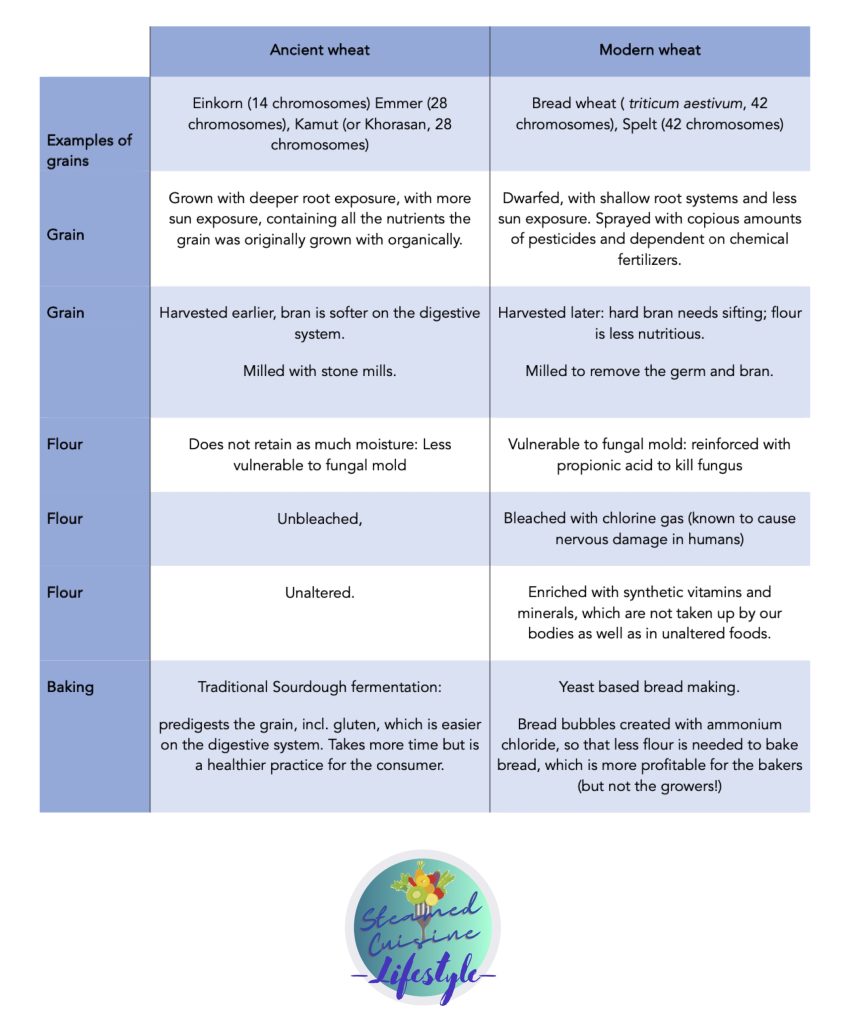
HERE IS A SUM UP COMPARISON OF YESTERYEAR’S GRAIN VS TODAY’S BASE ON MY READINGS
Reasons Behind My Choice To Use Einkorn
This table may trike you in a bad way: bad because you may, like me, feel like you really have to give up on today’s grain and go toward more expensive types, organic, and perhaps also ancient grain, einkorn perhaps, especially if like us you have family history of intestinal issues.
In my 8-year experience; it’s worth it! I feel like I am raising kids to appreciate the authentic tastes nature provides us with, as I was raised, and sparing them significant amounts of toxicity. Also, I’m less worried about their health, and relief of this kind of stress is huge to any parent!
Besides, the adoption of steamed cuisine combined with cutting modern wheat and (conventional) cow’s dairy significantly improved my husband’s allergy levels.
This is why I chose to use an ancient grain for my family’s needs. I do like wheat, I like bread (I mean, am I French or what?), I like to bake for my kids and with my kids. But I also want them to eat nutritious food rather than addictive, nutrition-devoid toxic foods.
One good argument in favor of choosing Einkorn is that whole einkorn has been proven to significantly lower blood sugar, while today’s conventional flour significantly raises it. [4] Why make my family sick in the long run?
Our family’s choice is to pay more, but use less ancient wheat that we otherwise would if it was modern wheat. We use no modern wheat in our diet except exceptionally (like when eating out or potlucks!) We also use wheat alternatives like (sifted) buckwheat, whole rice and rice flour, almond meal and flour, teff flour. Vary the sources also means varying the nutrient intake, the tastes, it makes life more interesting for our palates.
The good news then is we still get to make and eat delicious meals that involve wheat! I do make quiche and tartes and tortes and pies (even if I don’t bake a lot of deserts). On the quiche note, I also make a DELICIOUS moist crustless quiche cooked in the steam cooker, and I will post about it later! I also bake bread and cake in the steam cooker (try my chocolate cake and you’ll see!)
The tomato tarte
I make real pizza with einkorn crust. My husband may be biased but he says he loves it more than pizzeria’s pizza. Me too. And judging by my kids’ reaction to both store-bought organic pizza vs. mine, they like both, but they also prefer mine, hands down.


Recipe steps in order
NOW this meal IS NOT a pizza. This is a “tarte”. A tarte, in France, is not a desert, it’s a salty pie, with vegetables and seasonings over crust, but no filling like in quiches.
What I LOVE about this recipe is that it’s scrumptious even with bland tomatoes. I may hazard the statement that a good extra virgin olive oil is capable of catching up on any bland vegetable, but I may not fully agree with it…
[4] Rogosa p 15

Tomato and Old Style Mustard Tarte
Ingredients
- DOUGH:
- 3 c einkorn flour
- 3/4 cup water1/4 cup olive oil
- 2tsp salt
- FILLING:
- 3 lbs roma tomatoes, sliced ( don’t keep the upper and bottom slices)
- Half an onion, cut in thin slices
- 3 tbsp Old style mustard spread across the dough ( I will post how to make your own organic ancient style mustard for very cheap! )
- 4 tbsp Olive oil across the tarte
- 2 tbsp Oregano sprinkled across the tarte.
- Salt ( gently sprinkle salt all across the tomatoes)
- Cheese: Manchego 3 cups loosely grated cheese
Instructions
- In a bowl, pour the flour, salt, olive oil and slowly add the water, mixing with a wood spoon until the dough has taken in all the water but remains firm and not sticky.
- Let it sit for an hour or so, or spread right away. This dough does not need to rise!
- Spread it across a sheet of unbleached parchment paper, move the paper to a cooking sheet and keep spreading the dough with your fingers, raising the dough up the sides of the cooking sheets, up to half an inch/ ¾ inch approximately. It is okay if the dough spreads across an area of the sheet not covered by the paper, as this dough is not sticky. The paper is needed to make spreading the dough easier with a rolling spin, but once the rolling pin has spread out the dough, it will be hard to finish spreading the dough up the sides of the baking sheet. I usually transfer the paper and use my fingers to finish up.
- Using a silicone spatula, spread 3 tbsp of ancient style mustard across the dough.
- Grate the cheese ( I guy big cuts of cheese from Costco), and spread across the dough to loosely cover the whole surface over the mustard. Set aside.
- On a wood cutting board (I prefer, rather than eating traces of plastic!), slice the tomatoes widthwise, setting aside each extremity (I usually nib on them, or my children do). Better, enroll your kids to slice tomatoes! You will need the three pounds!
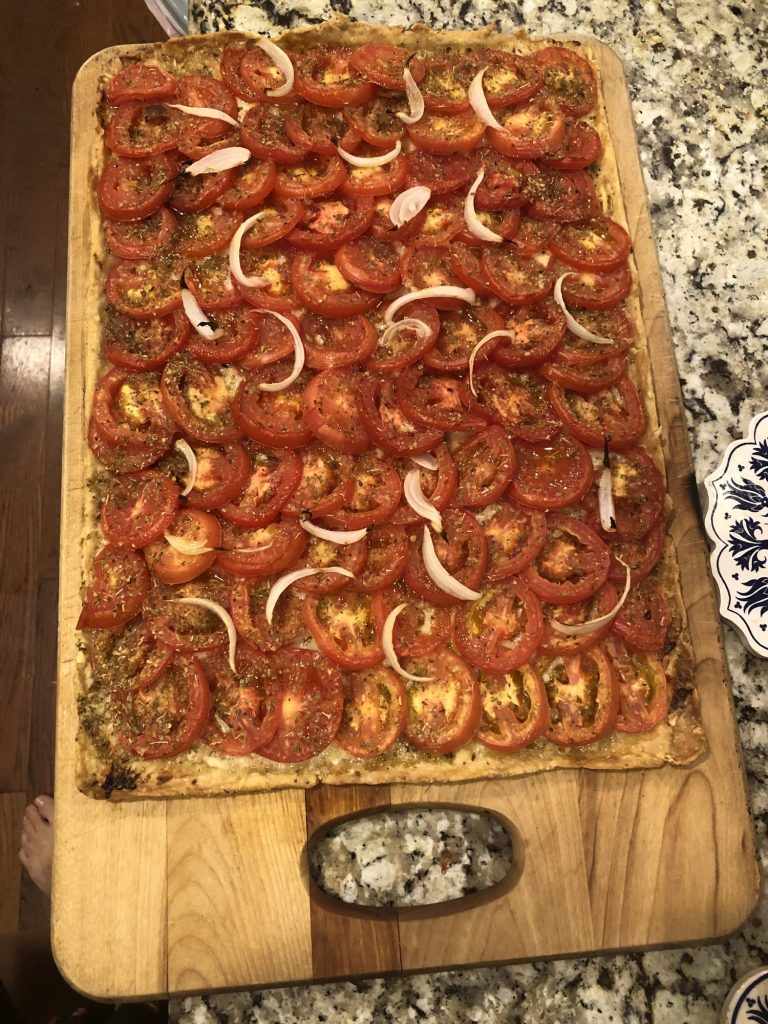
- Place the sliced tomatoes in line, each slice slightly covering the last slice’s end. The second line should cover the bottom end of the first row of tomato, so as to cover the whole surface of the dough. Fill up the whole surface of the dough.
- Once the tomatoes fill up the dough, add up any leftover slices in the holes as needed.
- Sprinkle the tomatoes with dried oregano and salt.
- Lightly pour some extra virgin olive oil all across the surface of the sheet. Pour about 1 tbsp of balsamic across as well.
- Place the sliced onions as decoration across the surface of the tarte.
- Turn on the grill and wait until it reaches 375°F ( or the oven, if you don’t mind heating up your house in the middle of summer).
- Bring the sheet, open the grill and place the sheet on the grill, and close.
- Bake for about 15 min, and check that it is cooked enough, and that the dough does not burn below. My last tomato and mustard tarte cooked for approximately 20 minutes at this temperature and the dough was perfectly firm and moist all at once, without burning anything. However, I like to check regularly to make sure since kids drama may make me forget about time!
- Remove the sheet from the grill (turn off the grill unless you need to grill a side of chicken like I did last!) , take the tarte off the sheet by pulling on the parchment paper onto a wood cutting board. Let cool for about 5 minutes, slice and serve! Bon appétit!
Notes
A FEW NOTES ABOUT MAKING THAT SCRUMPTIOUS TOMATO & MUSTARD TARTE:
- Make sure you use Roma tomatoes, which are less juicy, because that would transfer too much moisture onto the dough, which is already moisturized by the mustard and cheese.
- Oregano tastes so good on tomato. Don’t be shy! If you feel like you emptied your jar too fast, consider buying bulk of the herbs you use a lot. Frontier coop has DELICIOUS dried herbs, and they keep their taste a looooong time ! I once bought a whole POUND of bay leaves, needless to say I haven’t used them up yet, but they still taste and smell divine. Combine organic dried oregano with a good extra virgin olive oil, and get a fireworks of taste in your mouth.
- Ancient style mustard: I do make my own organic old style mustard. I do by Frontier Coop organic mustard grains and ferment the mustard in the fridge with water, vinegar salt and sugar for 2 weeks or more before I immersion blend it. For this recipe, you may need less mustard depending on how spicy your eaters can tolerate. My four kids do tolerate about 2.5/3 tbsp! And the homemade ancient style mustard is spicier than the retail one.
Three cups Manchego cheese sounds like a lot, but I don’t pack my cups of cheese, it will barely cover the surface of the dough, and won’t be thick. Feel free to use more or less!Did these details and pictures make you salivate yet?
Alright, you’re ready to jump to the recipe. Thanks for endulging my lengthy explanations, I hope they were at least somewhat entertaining!
Nutrition Information:
Yield: 10 Serving Size: 1Amount Per Serving: Calories: 1215Total Fat: 111gSaturated Fat: 22gTrans Fat: 0gUnsaturated Fat: 84gCholesterol: 37mgSodium: 910mgCarbohydrates: 45gFiber: 6gSugar: 4gProtein: 16g
These calculations are computer generated. They are apprximate, not accurate. They do not reflect the actual quality of the ingredients, and the health quality. Remember that your body does not only process calories but nutrients !